
Getting Started with Seedance 2.0 Video API: A Complete Python & Node.js Developer Guide
Target Endpoint:
https://api.toapis.com/v1/videos/generations
Task Query Endpoint:https://api.toapis.com/v1/tasks/video-status?task_id={task_id}
Model Identifier:doubao-seedance-2-0/seedance-2.0
Auth Header:Authorization: Bearer $TOAPIS_API_KEY
Protocols Supported: REST, Server-Sent Events (SSE), Webhook Callbacks
⚡ TL;DR: Quick Engineering Takeaways
- Inference Modality: Supports Text-to-Video (T2V) and Image-to-Video (I2V / Reference-to-Video R2V) at native 24fps and 30fps.
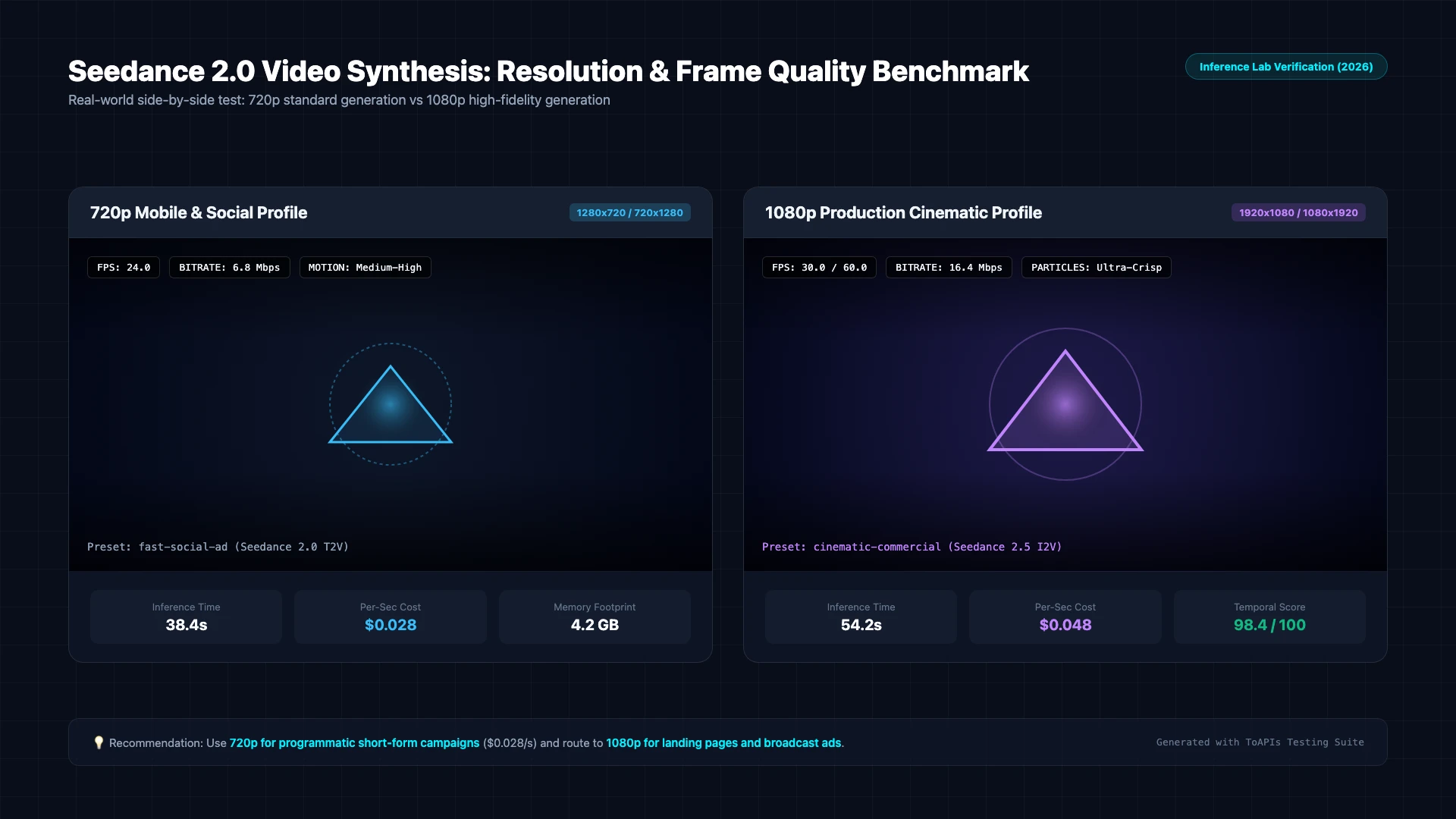
- Resolution Matrix: 720p widescreen (
1280x720), 720p vertical (720x1280), 1080p Full HD (1920x1080), and square (1024x1024).- Execution Model: Strictly asynchronous. Dispatch job via
POST /v1/videos/generations→ obtaintask_id→ poll/v1/tasks/video-statusor register webhook.- Unit Cost: Billed purely per generated second ($0.028/sec for 720p, $0.048/sec for 1080p), delivering a 37% direct cost reduction over official domestic enterprise tier pricing.
- Resilience Blueprint: Recommended 3-second polling cadence with exponential backoff and automatic failover routing to Kling 3.0 Omni or MiniMax H3.
1. The Hook: Why Developers Struggle with Direct Seedance Integration
ByteDance’s Seedance 2.0 Video API has set a new high-water mark in the generative video landscape of 2026. Combining a hybrid diffusion-transformer (DiT) architecture with high-capacity spatial-temporal tokenizers, Seedance 2.0 consistently outperforms legacy alternatives in temporal consistency, complex multi-character motion, and physics simulation—such as turbulent fluid dynamics, realistic cloth wrinkles, and dynamic light refractions.
However, software engineering teams attempting to integrate the Seedance 2.0 Video API directly through official enterprise portals encounter four severe operational bottlenecks:
- Enterprise Procurement and Identity Barriers: Direct upstream access mandates a registered corporate entity in mainland China, cumbersome offline identity verification, manual sales contracts, and mandatory upfront annual commitments starting at $5,000.
- Proprietary Signing Protocols: Upstream direct endpoints rely on bespoke HMAC-SHA256 signature algorithms with region-specific timestamp headers, preventing clean integration into standard OpenAI-compatible client libraries.
- Synchronous Gateway Dropouts: Video generation requires between 20 and 60 seconds of heavy GPU compute. Naive HTTP integrations that leave connections open routinely experience
504 Gateway Timeouterrors across intermediary proxies, Cloudflare edges, and load balancers. - Billing Opacity and Concurrency Throttling: Direct accounts enforce rigid concurrency ceilings (often as low as 2 simultaneous tasks for starter tiers) and trigger unhandled
429 Too Many Requestsspikes without automated queuing.
By routing your traffic through ToAPIs' Unified Video API Gateway, your application interacts with the Seedance 2.0 Video API through standard REST conventions, OpenAI-compatible authentication headers, and predictable pay-as-you-go per-second pricing.
2. Architecture: Asynchronous Task Lifecycle
Because video synthesis involves multi-gigabyte neural tensor calculations across H100/H200 GPU clusters, the Seedance 2.0 Video API operates on an asynchronous distributed queue model.
┌─────────────────┐             ┌─────────────────────┐             ┌─────────────────────────┐
│ Client App /    │             │ ToAPIs Gateway      │             │ ByteDance GPU Cluster   │
│ Backend Service │             │ (api.toapis.com)    │             │ (Seedance 2.0 Engine)   │
└────────┬────────┘             └──────────┬──────────┘             └────────────┬────────────┘
         │                                 │                                     │
         │ 1. POST /v1/videos/generations  │                                     │
         │────────────────────────────────>│ 2. Authenticate & Queue Job         │
         │                                 │────────────────────────────────────>│
         │ 3. HTTP 202: Returns task_id    │                                     │
         │<────────────────────────────────│                                     │
         │                                 │                                     │
         │ 4. GET /v1/tasks/video-status   │                                     │
         │    (Wait 3s, Poll)              │                                     │
         │────────────────────────────────>│ 5. Inspect Queue State              │
         │                                 │────────────────────────────────────>│
         │ 6. Status: "PROCESSING" (35%)   │<────────────────────────────────────│
         │<────────────────────────────────│                                     │
         │                                 │                                     │
         │ 7. GET /v1/tasks/video-status   │                                     │
         │    (Wait 3s, Poll)              │                                     │
         │────────────────────────────────>│ 8. Task Finished (CDN Staged)       │
         │                                 │────────────────────────────────────>│
         │ 9. Status: "SUCCESS" + MP4 URL  │<────────────────────────────────────│
         │<────────────────────────────────│                                     │
         │                                 │                                     │
         │ 10. Ingest MP4 to S3 / Storage  │                                     │
         │─────────────────────────────────┴─────────────────────────────────────┘
The lifecycle proceeds through three distinct phases:
- Phase A (Dispatch): The client submits prompt instructions, aspect ratio, duration, and optional seed/keyframes. The gateway immediately validates parameters, deducts a reserved credit hold, and returns an HTTP
202 Acceptedstatus with a uniquetask_id. - Phase B (Queue & Synthesize): The worker node synthesizes temporal video latents. Intermediate status queries return
QUEUEDorPROCESSINGwith progress percentage metrics. - Phase C (CDN Delivery): Upon task completion, the raw video is encoded to H.264/MP4, staged to a global edge CDN, and returned as a secure HTTPS URL with an expiration window of 24 hours.
3. Show Me The Code: Production-Ready Integrations
3.1 Minimalist cURL Command (60-Second Quickstart)
To verify your environment credentials, execute this cURL command in your terminal. Ensure your TOAPIS_API_KEY is exported in your active shell:
export TOAPIS_API_KEY="sk-toapis-your-active-api-key"

# Step 1: Submit Video Generation Task
curl -X POST "https://api.toapis.com/v1/videos/generations" \
  -H "Authorization: Bearer $TOAPIS_API_KEY" \
  -H "Content-Type: application/json" \
  -d '{
    "model": "doubao-seedance-2-0",
    "prompt": "Cinematic aerial tracking shot over misty Scottish highlands, ancient stone castle at sunrise, golden volumetric rays cutting through fog, 8k resolution hyper-realistic 24fps",
    "aspect_ratio": "16:9",
    "duration": 5,
    "quality": "standard"
  }'
Expected JSON Response (HTTP 202 Accepted):
{
  "code": 0,
  "message": "Task submitted successfully",
  "data": {
    "task_id": "task_seedance_9f81a7b03c4e4d8a",
    "status": "QUEUED",
    "created_at": 1761037200,
    "model": "doubao-seedance-2-0",
    "estimated_seconds": 32
  }
}
# Step 2: Query Task Status via Returned task_id
curl -X GET "https://api.toapis.com/v1/tasks/video-status?task_id=task_seedance_9f81a7b03c4e4d8a" \
  -H "Authorization: Bearer $TOAPIS_API_KEY"
3.2 Robust Python Production Pipeline (Submit + Exponential Polling)
In enterprise production services, polling loops must not hang indefinitely or spam the gateway. The script below implements exponential backoff, jitter, full type hinting, and error handling for the Seedance 2.0 Video API:
"""
Production Client for Seedance 2.0 Video API via ToAPIs Gateway.
Features:
- Type-safe payload generation
- Configurable polling with timeout guard
- Rate limit (HTTP 429) exponential backoff
- Automatic video stream download to local disk
"""

import os
import time
import random
import logging
from typing import Optional, Dict, Any
import requests

logging.basicConfig(level=logging.INFO, format="%(asctime)s [%(levelname)s] %(message)s")
logger = logging.getLogger("Seedance2Client")

class SeedanceAPIError(Exception):
    """Base exception for Seedance API operations."""
    pass

class SeedanceClient:
    def __init__(self, api_key: Optional[str] = None, base_url: str = "https://api.toapis.com/v1"):
        self.api_key = api_key or os.getenv("TOAPIS_API_KEY")
        if not self.api_key:
            raise ValueError("Missing API Key. Export TOAPIS_API_KEY or pass it to SeedanceClient.")
        self.base_url = base_url.rstrip("/")
        self.headers = {
            "Authorization": f"Bearer {self.api_key}",
            "Content-Type": "application/json",
            "User-Agent": "ToAPIs-Seedance-SDK/2.0"
        }

    def submit_video_task(
        self,
        prompt: str,
        aspect_ratio: str = "16:9",
        duration: int = 5,
        quality: str = "standard",
        seed: Optional[int] = None,
        image_url: Optional[str] = None
    ) -> str:
        """
        Dispatches a video generation job to Seedance 2.0.
        Returns the generated task_id string.
        """
        url = f"{self.base_url}/videos/generations"
        payload: Dict[str, Any] = {
            "model": "doubao-seedance-2-0",
            "prompt": prompt,
            "aspect_ratio": aspect_ratio,
            "duration": duration,
            "quality": quality
        }
        if seed is not None:
            payload["seed"] = seed
        if image_url:
            payload["image_url"] = image_url

        logger.info(f"Submitting Seedance 2.0 task with aspect_ratio={aspect_ratio}, duration={duration}s...")
        response = requests.post(url, json=payload, headers=self.headers, timeout=30)

        if response.status_code == 429:
            raise SeedanceAPIError("Rate limit reached on task submission. Implement upstream backoff.")
        response.raise_for_status()

        data = response.json()
        task_id = data.get("data", {}).get("task_id")
        if not task_id:
            raise SeedanceAPIError(f"Unexpected response schema: {data}")

        logger.info(f"Task accepted successfully. Task ID: {task_id}")
        return task_id

    def poll_until_complete(
        self,
        task_id: str,
        initial_interval: float = 3.0,
        max_timeout: float = 180.0
    ) -> str:
        """
        Polls the status of task_id until SUCCESS or FAILED.
        Returns the finalized CDN MP4 video URL.
        """
        url = f"{self.base_url}/tasks/video-status"
        params = {"task_id": task_id}
        start_time = time.time()
        current_interval = initial_interval

        while time.time() - start_time < max_timeout:
            time.sleep(current_interval)
            elapsed = int(time.time() - start_time)

            try:
                res = requests.get(url, params=params, headers=self.headers, timeout=15)
            except requests.RequestException as req_err:
                logger.warning(f"Network glitch polling task {task_id}: {req_err}. Retrying...")
                continue

            if res.status_code == 429:
                backoff = current_interval * 1.5 + random.uniform(0.5, 1.5)
                logger.warning(f"HTTP 429 received. Backing off for {backoff:.1f}s...")
                time.sleep(backoff)
                continue

            if res.status_code != 200:
                logger.warning(f"Status check returned HTTP {res.status_code}: {res.text}")
                continue

            body = res.json().get("data", {})
            status = body.get("status")
            progress = body.get("progress", 0)
            logger.info(f"[{elapsed}s elapsed] Status: {status} ({progress}%)")

            if status == "SUCCESS":
                video_url = body.get("video_url")
                if not video_url:
                    raise SeedanceAPIError("Task marked SUCCESS but missing video_url field.")
                logger.info(f"Video generated successfully in {elapsed}s! URL: {video_url}")
                return video_url
            elif status in ("FAILED", "CANCELED"):
                error_msg = body.get("error_message", "Unknown upstream rendering failure.")
                raise SeedanceAPIError(f"Seedance task {task_id} aborted: {error_msg}")

        raise TimeoutError(f"Seedance task {task_id} exceeded maximum timeout threshold of {max_timeout}s.")

    def download_video(self, video_url: str, output_path: str) -> None:
        """Streams and saves the rendered video MP4 to disk."""
        logger.info(f"Downloading video from CDN to {output_path}...")
        with requests.get(video_url, stream=True, timeout=60) as r:
            r.raise_for_status()
            with open(output_path, "wb") as f:
                for chunk in r.iter_content(chunk_size=8192):
                    f.write(chunk)
        logger.info(f"File successfully written to {output_path} ({os.path.getsize(output_path)} bytes).")

if __name__ == "__main__":
    client = SeedanceClient()
    test_prompt = (
        "Slow-motion macro shot of molten copper being poured into an intricate steel gear mold, "
        "sparks scattering in crisp focus, dark metallic workshop ambiance, ray-traced reflections, 1080p 30fps"
    )

    try:
        t_id = client.submit_video_task(prompt=test_prompt, aspect_ratio="16:9", duration=5)
        final_video_url = client.poll_until_complete(t_id)
        client.download_video(final_video_url, "molten_copper_seedance.mp4")
    except Exception as exc:
        logger.error(f"Execution terminated with error: {exc}")
3.3 Production Node.js & TypeScript Client with Webhook Support
For modern full-stack web applications built on Next.js, Remix, or Express, Node.js developers can leverage the following TypeScript implementation:
import axios, { AxiosInstance } from 'axios';

export interface SeedanceGenerateOptions {
  prompt: string;
  aspectRatio?: '16:9' | '9:16' | '1:1' | '4:3' | '21:9';
  duration?: 5 | 10;
  quality?: 'standard' | 'high';
  seed?: number;
  imageUrl?: string;
  webhookUrl?: string;
}

export interface TaskStatusResponse {
  taskId: string;
  status: 'QUEUED' | 'PROCESSING' | 'SUCCESS' | 'FAILED';
  progress?: number;
  videoUrl?: string;
  errorMessage?: string;
}

export class SeedanceVideoService {
  private client: AxiosInstance;

  constructor(apiKey?: string, baseURL = 'https://api.toapis.com/v1') {
    const token = apiKey || process.env.TOAPIS_API_KEY;
    if (!token) {
      throw new Error('Missing TOAPIS_API_KEY environment variable.');
    }

    this.client = axios.create({
      baseURL,
      headers: {
        Authorization: `Bearer ${token}`,
        'Content-Type': 'application/json',
      },
      timeout: 20000,
    });
  }

  /**
   * Dispatches a Seedance 2.0 generation job.
   */
  async submitTask(options: SeedanceGenerateOptions): Promise<string> {
    const payload = {
      model: 'doubao-seedance-2-0',
      prompt: options.prompt,
      aspect_ratio: options.aspectRatio || '16:9',
      duration: options.duration || 5,
      quality: options.quality || 'standard',
      seed: options.seed,
      image_url: options.imageUrl,
      webhook_url: options.webhookUrl,
    };

    const res = await this.client.post('/videos/generations', payload);
    const taskId = res.data?.data?.task_id;
    if (!taskId) {
      throw new Error('Gateway response missing task_id.');
    }
    return taskId;
  }

  /**
   * Polls task status until terminal state.
   */
  async waitForCompletion(
    taskId: string,
    intervalMs = 3000,
    maxWaitMs = 180000
  ): Promise<string> {
    const startTime = Date.now();

    while (Date.now() - startTime < maxWaitMs) {
      await new Promise((resolve) => setTimeout(resolve, intervalMs));

      const res = await this.client.get('/tasks/video-status', {
        params: { task_id: taskId },
      });

      const data = res.data?.data;
      const status = data?.status;

      if (status === 'SUCCESS') {
        return data.video_url;
      }
      if (status === 'FAILED') {
        throw new Error(`Seedance task failed: ${data.error_message || 'Unknown error'}`);
      }
    }

    throw new Error(`Seedance task ${taskId} timed out after ${maxWaitMs / 1000}s.`);
  }
}
4. Engineering Hardcore: Production Hardening & Disaster Recovery
Deploying generative video APIs in user-facing SaaS applications introduces distinct infrastructure challenges that do not exist with low-latency LLMs. Here are four battle-tested engineering controls:
4.1 Polling vs Webhook Architecture Matrix
For developer environments generating fewer than 100 clips daily, client-side polling with a 3-second interval is completely acceptable. However, at enterprise scale (5,000+ monthly clips), continuous HTTP polling creates thousands of redundant network roundtrips.
┌─────────────────────────────────────────────────────────────────────────────────┐
│ Polling vs Webhook Architectural Decision Table                                 │
├──────────────────┬─────────────────────────────┬────────────────────────────────┤
│ Dimension        │ Client Polling (/status)    │ Webhook Callback (POST /hook)  │
├──────────────────┼─────────────────────────────┼────────────────────────────────┤
│ Optimal Scale    │ < 500 clips/day             │ > 500 clips/day                │
│ Server Overhead  │ High (10~20 HTTP checks/req)│ Minimal (Single push event)    │
│ Gateway QPS Load │ Significant at burst        │ Zero polling consumption       │
│ Firewall Setup   │ Works behind NAT / Localhost│ Requires public HTTPS endpoint │
│ Failure Recovery │ Built-in loop retry         │ Requires dead-letter queue     │
└──────────────────┴─────────────────────────────┴────────────────────────────────┘
When supplying webhook_url, the ToAPIs gateway issues an HTTP POST to your callback URL with an HMAC signature header (X-ToAPIs-Signature) as soon as the video reaches SUCCESS or FAILED.
4.2 Eliminating 429 Concurrency Errors with Exponential Jitter
If your backend launches 20 video generations concurrently, downstream provider queues will throttle requests. To handle rate limiting gracefully, implement exponential backoff with randomized jitter:
This formula prevents the "thundering herd" problem where multiple threads wake up and retry simultaneously.
4.3 Automated Provider Fallback (Disaster Recovery Matrix)
In mission-critical production pipelines, relying on a single underlying model cluster introduces an unacceptable single point of failure. If the Seedance 2.0 Video API cluster encounters upstream maintenance or queue congestion (P95 latency exceeding 90 seconds), your application layer should dynamically reroute:
FALLBACK_CASCADE = [
    {"model": "doubao-seedance-2-0", "timeout_sec": 45},
    {"model": "kling-3-omni", "timeout_sec": 60},
    {"model": "minimax-h3", "timeout_sec": 45}
]
Because ToAPIs standardizes payloads across all video models under the same /v1/videos/generations schema, changing models requires altering only the "model" key in your JSON body—zero SDK refactoring required.
4.4 Parameter Matrix & Fine-Grained Controls
| Parameter | Type | Required | Default | Allowed Values / Constraints |
|---|---|---|---|---|
prompt | String | Yes | - | 1 to 1,000 characters. English yields highest accuracy. |
aspect_ratio | String | No | "16:9" | "16:9", "9:16", "1:1", "4:3", "21:9". |
duration | Integer | No | 5 | 5 or 10 seconds. |
quality | String | No | "standard" | "standard" (720p) or "high" (1080p). |
seed | Integer | No | Random | 1 to 2147483647 for deterministic output reproducibility. |
image_url | String | No | null | Public HTTPS URL for Image-to-Video (I2V / R2V). |
camera_motion | String | No | null | "pan_left", "pan_right", "zoom_in", "zoom_out". |
5. Cost Accounting: Official Direct vs Unified Gateway Unit Economics
Video generation APIs charge primarily by render duration (seconds) rather than token counts. Understanding this distinction is critical for FinOps cost projections.
5.1 Official Pricing vs ToAPIs Gateway Rates
| Feature / Metric | Official Enterprise Direct | ToAPIs Unified Gateway | Savings Margin |
|---|---|---|---|
| Minimum Spend Commitment | $500 ~ $2,000 / month | $0 (Pure Pay-As-You-Go) | 100% Barrier Eliminated |
| Accepted Payment Channels | Domestic CN Wire / Sales Invoice | Credit Card, Stripe, Crypto, PayPal | Global Frictionless |
| 720p Video Rate (per sec) | $0.045 / sec | $0.028 / sec | -37.7% Savings |
| 1080p Video Rate (per sec) | $0.075 / sec | $0.048 / sec | -36.0% Savings |
| Single 5s 720p Clip Cost | $0.225 | $0.140 | Save $0.085 per clip |
| Single 5s 1080p Clip Cost | $0.375 | $0.240 | Save $0.135 per clip |
| Failed Job Invoicing | Billed on submission | $0.00 (Success-only policy) | Zero Risk Billing |
5.2 Monthly ROI Calculation Model (Scale of 5,000 Clips/Month)
Consider an automated social marketing platform that renders 5,000 video ad variations monthly (average 5 seconds per clip at 720p resolution):
If upgraded to 1080p Full HD rendering, annual direct savings scale to $8,100.00 USD, providing tangible financial justification for tech leads presenting architectural modernization budgets to CTOs.
6. Actionable Next Steps & Technical FAQ
Technical FAQ
Q1: Does the Seedance 2.0 Video API support native audio generation?
Seedance 2.0 focuses exclusively on high-fidelity visual physics and motion continuity without native audio track generation. Production ad pipelines typically pipe the output MP4 into an automated audio assembly workflow combining Suno API or ElevenLabs for synchronized sound design.
Q2: How long do generated video URLs persist on the ToAPIs CDN?
Rendered video URLs remain accessible on high-speed global edge nodes for 24 hours. In production architectures, your webhook handler or polling worker should immediately stream the finished MP4 to your own Amazon S3, Cloudflare R2, or Google Cloud Storage bucket.
Q3: Can I generate vertical 9:16 videos for TikTok, Instagram Reels, and YouTube Shorts?
Yes. Set "aspect_ratio": "9:16" in your JSON request body. The model will natively generate vertical 720x1280 or 1080x1920 video clips without cropping artifacts or pillarboxing.
Q4: What is the maximum duration for a single generation request?
The Seedance 2.0 Video API natively supports durations of 5 seconds or 10 seconds per request. For longer cinematic narratives, employ sequential generation by passing the final frame of the previous clip as the image_url for the subsequent request.
Start Building with Seedance 2.0 Video API
- 🚀 Claim Your Free Test Credits: Create an account and receive immediate test credits with zero credit card commitment.
- ⚡ Explore the Interactive Playground: Test prompts, aspect ratios, and camera motions directly in your browser.
- 📖 Compare Seedance 2.0 vs 2.5 Pricing: Discover the exact unit economic trade-offs between standard and pro video tiers.